

Clinically-Tested Sun Protection for UV, Blue Light & Skin Barrier Support
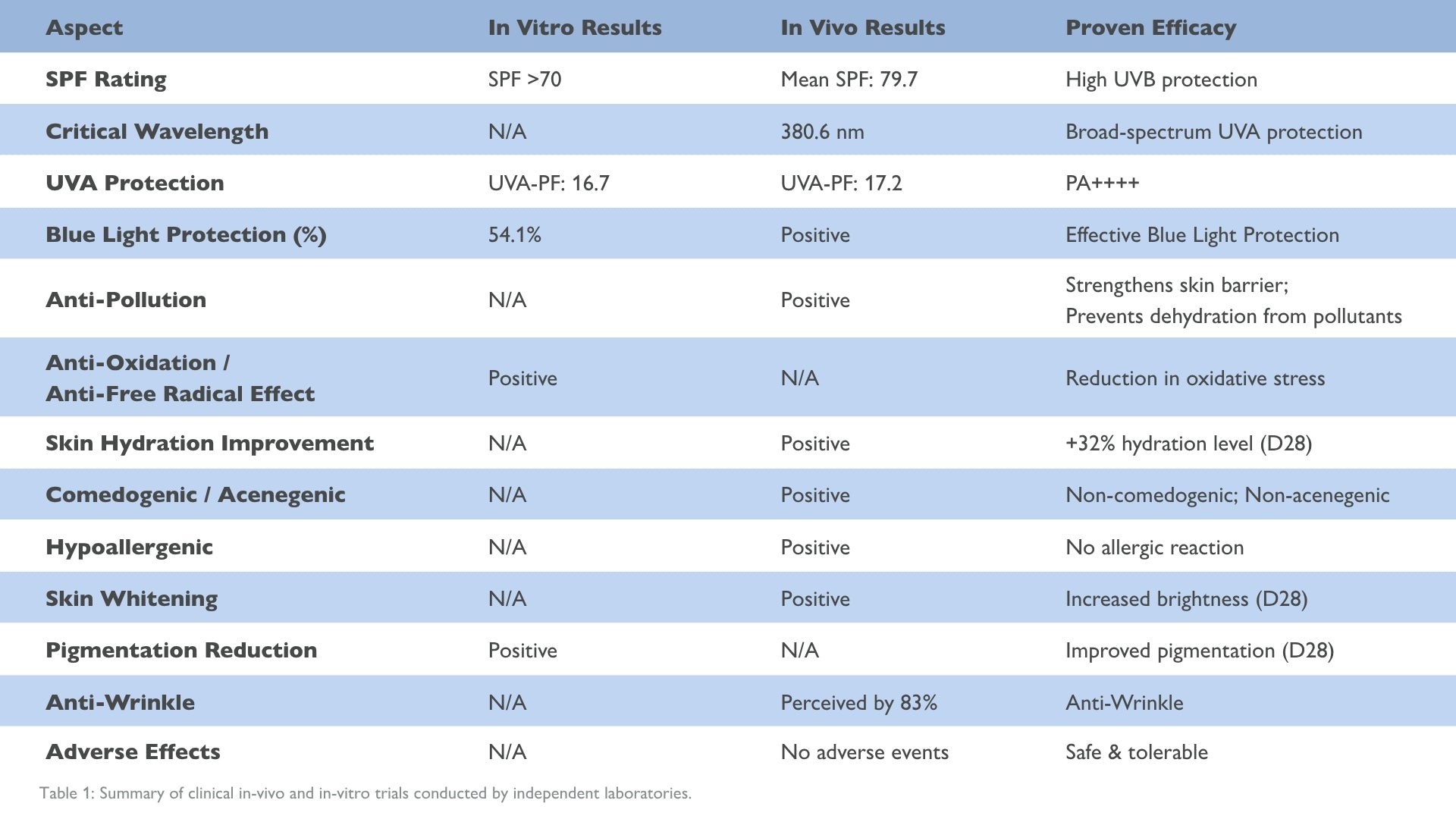
Crystal Tomato® Beyond Sun Protection is a broad-spectrum sunscreen developed for pigmentation-prone and sensitive skin. Its efficacy has been assessed across a series of independent in vitro and in vivo studies covering UVB and UVA protection, blue-light protection in the laboratory and on human skin, antioxidant and anti-free-radical activity, protection against particulate pollution, skin barrier recovery, and skin comfort and tolerability. Testing has been conducted by Eurofins Dermatest (Australia), Eurofins EVIC (Romania), CIDP (Singapore and Mauritius), Group Dermscan (Poland and Tunisia) and Complife Beijing Testing Technology (China). This page sets out what was tested and what the results mean for daily protection.
The Study at a Glance
Beyond Sun Protection has been evaluated across multiple independent studies using both in vitro and in vivo methods. SPF was measured in vivo on 10 subjects to ISO 24444 and UVA protection in vivo on 10 subjects to ISO 24442; UVA critical wavelength and in vitro UVA protection were measured to ISO 24443. Blue-light protection was measured in vitro across the 380-500 nm range and then tested on human skin in a 22-subject study. Antioxidant activity was assessed in a 22-subject study using β-carotene photodegradation under repeated UVA exposure, and protection against fine-dust pollution in a further 22-subject study using transepidermal water loss, skin hydration and skin pH. Tolerability was assessed separately in a 53-subject repeat-insult patch test and a 20-subject comedogenicity study under dermatological control. Skin barrier recovery was assessed by Complife Beijing Testing Technology, measuring transepidermal water loss (TEWL) after experimentally induced barrier disruption.
Key Finding 1: Broad-Spectrum SPF 79+ and PA++++ UVA Protection
In vivo testing measured an SPF of 79.7 (ISO 24444) and a UVA protection factor of 17.2 (ISO 24442), corresponding to PA++++, the highest UVA protection grade. In vitro testing measured a UV critical wavelength of 380.6 nm (ISO 24443).
What this means: SPF 79+ indicates very high protection against UVB, the wavelength that causes sunburn, while PA++++ indicates very high protection against UVA - the wavelength most associated with pigmentation and premature ageing. A critical wavelength of 380.6 nm confirms that protection is spread across the UVA range rather than concentrated at one point in it.
Key Finding 2: Blue-Light Protection in Laboratory and Human-Skin Testing
In vitro testing measured 54.1% blue-light protection across the 380-500 nm range, with a blue-light critical wavelength of 393 nm. In a CIDP study involving 22 participants with Fitzpatrick III-IV skin, treated and untreated areas were exposed to blue light and assessed using a Chromameter. The study concluded that Beyond Sun Protection demonstrated protective efficacy against blue-light induced pigmentation.
What this means: The 54.1% figure is an in vitro measurement of blue-light protection by the product film. The separate study on human skin assessed protection against blue-light-induced pigmentation in Fitzpatrick III-IV skin tones. The laboratory percentage is not a percentage reduction in pigmentation on human skin.
Key Finding 3: Antioxidant and Anti-Free-Radical Activity
In in vivo testing on 22 participants at Dermscan Poland, Beyond Sun Protection demonstrated significant antioxidant and anti-free-radical activity following repeated UVA exposure. In the test model, β-carotene was applied to defined areas of skin and then exposed to increasing doses of UVA; how fast it breaks down indicates oxidative damage. Protected skin retained more β-carotene than unprotected skin at every dose tested, including 44.7% against 24.9% at the highest exposure (p<0.0001).
What this means: UVA exposure generates free radicals and oxidative stress in the skin. These findings demonstrate the formula's antioxidant and anti-free-radical activity under repeated UVA exposure, providing an additional layer of defence alongside its UV and blue-light protection.
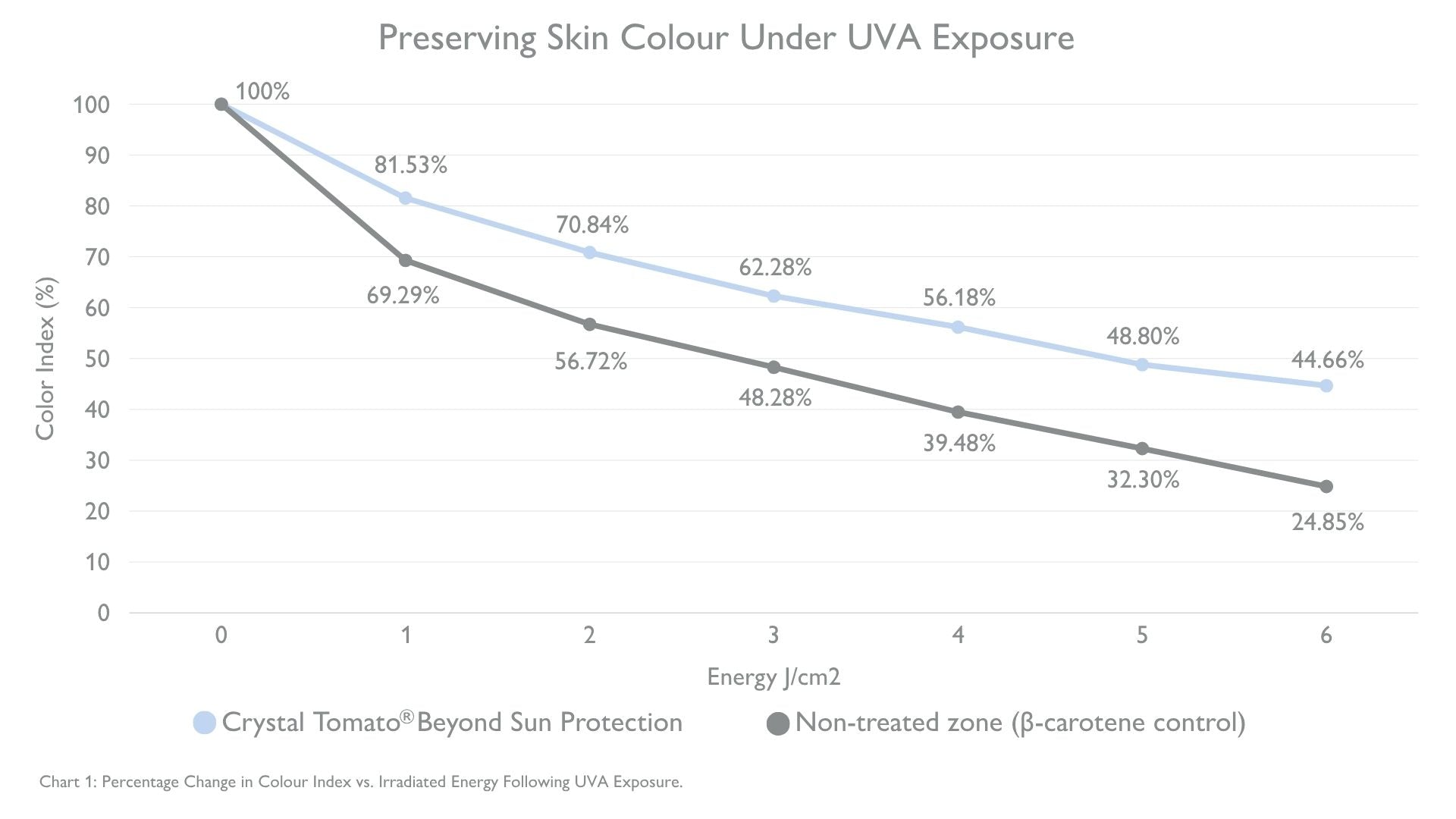
This chart shows that Crystal Tomato® Beyond Sun Protection retains a higher percentage of β-carotene compared with unprotected skin as UVA exposure increases — indicating less oxidative breakdown. Protected skin retained more β-carotene at every dose tested, demonstrating significant antioxidant and anti-free-radical activity under repeated UVA exposure.
Key Finding 4: Protection Against Particulate Pollution
In a CIDP study of 22 volunteers, treated and untreated areas of skin were exposed to fine dust and assessed by transepidermal water loss (TEWL), skin hydration and skin pH. Compared with untreated exposed skin, treated skin showed a slight improvement in skin barrier function and better maintenance of hydration. Skin pH was the only measure on which the difference between treated and untreated skin reached statistical significance (p = 0.035), which the investigators interpreted as the skin's slightly acidic mantle being maintained. They concluded that the product “has a tendency to protect the skin” against the effects of particulate pollutants. The product was very well tolerated and no adverse events were recorded.
What this means: The study provides preliminary evidence of protection against fine-dust exposure. The skin-pH difference reached statistical significance; the barrier-function and hydration differences did not. This is why the investigators described a tendency to protect the skin.
Key Finding 5: Support for the Skin's Moisture Barrier
In a study by Complife Beijing Testing Technology, the skin barrier was first disrupted under controlled conditions and Beyond Sun Protection was then applied once. Following this single application, transepidermal water loss (TEWL) decreased by 32.6% at 60 minutes and 36.6% at 24 hours, and was significantly lower than on untreated skin at both time points (p < 0.05).
What this means: TEWL measures how quickly water escapes through the skin, so lower TEWL means the barrier is holding moisture in more effectively. After the barrier had been disrupted, treated skin lost significantly less water than untreated skin at 60 minutes and at 24 hours - indicating that the formula helps support the skin's moisture barrier when it has been compromised.

Suitable for Sensitive Skin
Beyond Sun Protection is hypoallergenic, non-comedogenic and tested under dermatological control, and is formulated for sensitive skin. It can be used daily as the protective final step alongside Crystal Tomato's other clinically studied products, the Whitening Supplement and Skin Clarity Cream.
Frequently Asked Questions
Is Beyond Sun Protection suitable for daily use?
Does it protect against blue light?
Is it suitable for sensitive skin?
How can it help pigmentation-prone skin?
Does it help protect my skin from pollution?
Does it support the skin's moisture barrier?
Study attribution
Efficacy and tolerability testing was conducted by independent laboratories including Eurofins, CIDP, Group Dermscan and Complife Beijing Testing Technology, using the finished product. References to these institutions describe where testing took place and do not imply endorsement. Results may vary depending on individual skin type and usage.
High UV & Blue Light Protection
A broad-spectrum formula with SPF79+, PA++++, designed for sensitive skin & ultimate protection.
Downloads and product link
Other Clinical Evidence

Whitening Supplement:
Clinically Proven to Reduce
Pigmentation and Improve Skin Tone
National Skin Centre Clinical Study
VIEW STUDY EXPLORE ALL CLINICAL STUDIES
Whitening Supplement:
Before-and-After Results
National Skin Centre Clinical Study
VIEW STUDY EXPLORE ALL CLINICAL STUDIES
Skin Clarity Cream:
Before-and-After Results
Eurofins France
VIEW STUDY EXPLORE ALL CLINICAL STUDIES